Showing posts with label NT. Show all posts

Thursday, 25 June 2026

Utter Fabrication!

The phrase means "a lie -  totally made-up". But the other week, Bob and I visited an utterly fabulous exhibition of fabrics from all around the globe. Entitled "journeys" and displayed at Blickling Hall, our local NT property, it was just a part of a lifetime's collection of fabrics, amassed by Karun Thakar. Born in Kenya, growing up in Delhi finally settling in the UK, this man has been obsessed with textiles since childhood. There is a helpful explanatory video here [I'm putting KTs quotes in red.]We began in the entrance hall- KT says "the hall has a lot of portraits of men...so we wanted to bring the presence of women's work into the hallway"


We saw  kanthas, and baghs - the former , bedquilts made from saris or repurposed fabrics, the latter, head shawls worn at festivals and weddings. A riot of colour, a diversity of stitching- representing the realities of rural and local life. 'In the textiles, needles became tools of agency and remembrance for women'

In the Brown Drawing Room, KT chose to display lots of Indian textiles. in 1938, Philip Kerr,Blickling's last owner, invited Jawaharlal Nehru and his daughter Indira Gandhi here, to discuss the future of an independent India. A Kashmir shawl, Gujurat hangings and a palampore [block printed cotton wall hanging] The British East India Company [founded 1600] exported Indian fabrics to Europe, and they became instantly fashionable. I was sorry that no reference was made to the Norwich Shawl [a number of reviewers have picked up this point!]
The prints in the Print Room were mostly collected  by an earlier owner of the Hall, John Hobart on his travels in Italy. John had eight children, four of whom died very young. He never recovered from this loss. KT chose to display this unfinished Italian silk-on-linen embroidery to represent their unfinished lives..."I am fascinated by unfinished textiles because they represent all sorts of possibilities...a thing of curiosity that leaves the gaps for the viewer to fill in"
In the South Drawing Room, KT reflects colonial trading power. The East India Company brought in the chintz printed fabric in the 1600s but this affected English and French producers. The Calico Acts were passed in the 1700s - and European textile production, like these French toile du Jouy designs flourished, whilst increased colonial activity in the subcontinent decimated the Indian industries.
In the Upper Ante Room Blickling has a collection of Japanese object - here KT displayed some of his kimonos [the guide told us he has thousands in store!]

In the Peter the Great Room, there were, unsurprisingly , many robes from the Russian Empire - " I want to show the diversity of people living across Russia in the 1800s...ikat robes, and Arabichi coats

The Long Gallery and Library housed some fabulous African printed fabrics - kente cloth made from silk and cotton traded across the world as early as the 1500s/

The whole thing was a riot of colour, and beautiful stitchery. As I went from room to room ,there were many other visitors [mostly women], admiring, discussing, comparing the textiles. It was good to talk with other people who share my passion for working with fabric, restoring old materials, reclaiming forgotten techniques ....
It is a good, worth seeing. But Bob and I both felt the information panels were a little short on facts- which places in Russia were represented by those robes,  how did the designs link across the world? Where are they telling the story of how the boteh motif of India appearing on the Norwich shawl, and then on Paisley shawls and now often called a Paisley Pattern? what was the symbolism of the different colours used?  I did feel sorry for the volunteer NT guides, because many of the visitors were asking these questions, and they were not sufficiently equipped to answer them. 
But that deficit means I only award 4*

Tuesday, 2 June 2026

We Are Not 'Posh Grandparents'

According to the fashion writers, the style for this season is 'Posh Grandpa'.  I kid you not. Style points; vintage jackets or blazers, check or cord trousers [not jeans], loafers or laced brogues [not trainers], waistcoats or woollen sleeveless slipovers. Well, I checked, and I can produce all of those items from my wardrobe. And Bob has most of them in his size too. 

But it's flaming June out there!!
Personally I would prefer to be in a diaphanous dress like Lord Leighton's beauty* today rather than wrapped up like an aged Oxford Professor in December.
I checked out Jane and Beryl [aka The Ministry of Style.] Have you come across these two friends in their sixties, who suddenly found their jokey fashion posts going viral during Covid

Their comment on dressing like Posh Grandpas is hereI found B&J amusing in the early days, when their videos were not quite so polished, but now they have upped their game and become a teensy bit too smug for me. In their mid 60s, it was initially a bit of a game in retirement, but now they are making a living as 'influencers'. So they are sponsored by various clothing and cosmetic companies. I suspect they were not short of a bob or two to start with. Jane, the tall one, was an accomplished artist and milliner, [her hat company supplied Harrods]

Many of the videos are shot in her house [which could belong to the NT] When I started watching them I discovered some fun portmanteau words [wearing a Breton top makes me striped-boobed or "stroobed"] and the Acorn Antiques clips are a scream.

But I wondered about tall Jane's coloured pointy stick, used to indicate fashion points on Beryl's shorter, dumpier body  What is it?
Well done if you correctly identified it as a Croquet Stake! I mean, doesn't everyone have one of them lying around? The Ministry Of Style Ladies are a lot posher than me! Btw I'm a Compact Beryl rather than a Statuesque Jane. 
Do you dress like a Posh Grandpa?
Have you watched any Ministry of Style clips?

*but wearing more underwear than she is, obviously


Monday, 6 April 2026

What I Did In The Holidays

Start of term, our writing task. . The highlight for me had been going with my Mum to a rather posh Garden Party. I was 6, and had to present some flowers to the important guest of honour. All summer, I'd practised presenting [not dropping] said flowers,  smiling and curtseying to The Lady.

I wrote about the garden, and the cakes, and then wrote "I gave a bokay to a Lady" My teacher didn't know what a bokay was. She interrogated me at length about this word. I tried to explain to her, I even showed her how to curtsey. She asked the class, and none of them knew about bokays. "Angela, I think this is an imaginary word you have made up." Everyone laughed at me. I cried tears of frustration. I thought everybody knew about bokays, after all, the Queen has them. When Mum collected me from school, she explained about the bouquet. But I was a miserable wreck, and felt the Most Important Day in my holidays had been belittled. But that was 1961, now I am happier talking about holidays!
On Monday morning we went to Felbrigg Hall [NT] and did their splendid Easter Trail. Bob borrowed a mobility scooter and he was able to accompany the Jess and Ro on the whole trail. The scooters are a free service and very well organised. The girls played games on the grass, built dens, found clues, and made music in the woods. The trail cost £3.50 each, but they received a quality chocolate egg at the end. 

Monday afternoon we made Easter cards, and then made and decorated pizzas. The girls had a sleepover.
Tuesday we did more crafts - painting rabbits, and making baskets for egg collection. Jess had asked Grandad to make a sign for her door on a piece of bark she'd found. It was rather soggy, and when Grandad explained, she was happy to have a sign on a better piece of wood. He made Rosie one too.
Then on Thursday I went with the family to BeWILDerwood. Bob and I took Rosie to this theme park back in 2023, for an evening event, I had never been in the daytime before. It was great fun with treetop walkways, zipwires, mazes, slides, and other energetic activities. Plus gentler stuff - facepainting, crafts, story time, puppets, a boat ride and facepainting. And another Easter Trail to follow. We were there from 11am till 4pm, and really enjoyed ourselves. 
Overall verdict: all good, 5*venues.
The NT day was good - three of us have membership, and Jess is under 5, so we only had to pay for the Easter Egg Trail. The snacks from the food caravan were very generously sized - the girls shared their chocolate brownie, and I took half my pasty home for later. Facilities for the less mobile were excellent, and all the staff were so friendly and helpful. 
BeWILDerwood was a little more expensive [but we spent 5 hours there]  Unlike Felbrigg, where we saw lots of people clearly doing Granny-Duties, at the theme park, there were far more parents-with-children. I suspect that is because there is a lot of walking, and terrain is a bit bumpy for mobility scooters. [Bob was busy anyway, so didn't come with us]
That said, it is very well laid out, with lots of places to sit down if your little legs [young or old] get tired, and plenty of clean, well maintained loos dotted about the site [no need for surreptitious Tree Wees!] The food cabins do not charge excessive prices [we took a picnic, but bought hot drinks when it turned chilly] There were picnic benches and well labelled litter bins.  
Again the young staff were engaged and relentlessly cheerful. They were word perfect in recounting the stories of the Twiggles and the Boggles, and Cedric the Easter Bunny. 
As we left, the girls each got bags of sweets for completing their worksheets. We were all very tired but happy.
Those are some of the things I did in the Easter Holidays, and we were grateful for the opportunity to spend time with the family. I hope you had a good Easter too...

Saturday, 21 March 2026

One For Sorrow, Two For Joy...

This is the logo of The Magpies, aka Dereham Town Football Club. Norfolk boasts a number of FCs with bird nicknames [Norwich Canaries, Kings Lynn Linnets, Reepham Robins...] Founded in 1884 as Dereham FC, merging in 1986 with a Sunday league team, to become Hobbies United - in 1991 named Dereham Town FC.

This year, 2026, marks 60 years since the first name change, and our local museum is making this a year of sport [we just had the Winter Olympics] So Katie asked how we could bring the Museum Mice up to speed on this.
I said that creating sports gear for the mice was a bit of a challenge - why not dress them as footie fans, and give them all hats and scarves? And I'd got black and white wool in my stash...
Oh no I hadn't! Lots of white dk, but somehow almost all my black wool got used up when I donated it to some poppy-knitters. I bought a cheap ball of black dk and set to, producing first scarves and then hats. And the hats needed pompoms. 
"Why is there a small fork on the coffee table?" asked Bob. "It's mine, I said defensively, "my first ever fork, it used to have a little spoon with is but that got lost decades ago"
"Buy why is it on the coffee table?"  "It is perfect for making Mini PomPoms"

That really is black wool, it just looks navy in the picture! Here's a diagram.   Choose a fork the width of your finished pompom.

 Thread the ends round between central tines a few times [use a darning needle] and tie tight. Cut and trim.

The project is going very speedily, I'm making hats with both white and black pompoms. The mice should look splendid! I decided to polish up my little fork, so got out the giant tin of Brasso. Don't forget, if you polish a piece of cutlery with Brasso or Duraglit, you should wash it in regular w/u liquid afterwards before using it for food.

Have you ever made mini pompoms?

Do you support a football team? [I don't] 

Do you still use metal polish? [The National Trust polish their copper and silverware just once a year before the start of the season]

Magpie began on ITV in 1968, it was intended as a rival to BBC's Blue Peter which began ten years earlier. Magpie ran for just 12 years. BP is still going, approaching its 70th birthday, it's the longest running children's TV show in the world

Friday, 19 September 2025

Ang Goes To Anglesey

No, not the Welsh place, but Anglesey Abbey, the NT property in Cambridgeshire. It has been on my wish list for years. I put it on my 70s list back in April. When Bob said on Tuesday morning "have you got a lot to do today?" I realised it was the only day this week without commitments [other than housework. Which doesn't count] "Can we go to Anglesey Abbey?" I suggested [he thought it was in Wales so was reluctant at first ]

It took about an hour to reach this National Trust property. We arrived just before 11am and drank coffee in the car [yes, we thriftily took our own flask, and Tunnocks wafers!] There was plenty going on, the welcome guy enthused about the bookshop, the restaurant, the little cafĂ©, the gardens [especially the dahlia garden and the cyclamen walk] the house, and the special autumn exhibition about men's tailoring... Suffice it to say we were there till gone 3pm. 
Founded as "Hospital of St Mary"  in 1135 by Henry 1, converted in C13 to an Augustinian Priory, in 1536, Henry VIII dissolved priory and gave it to a lawyer. He took much of the roof and bricks to build nearby Madingley Hall, leaving the Abbey to decay. [careless chap] Owned by a couple of other men, then acquired by the Downing Family . They were founders of the Cambridge College, and the Street in London was named after the one who acquired New York from the Dutch. Then an MP, and a Vicar owned it.

Huttleston Rogers Broughton, was the eldest son of a Very Wealthy Englishman [Urban Hanley Broughton] and his American wife [Cara Leland Rogers] Cara's grandad was one of the 25 richest men in US history]  HRB bought the property in 1922, along with his brother Henry. Huttleston and Henry agreed that the first to marry would sell his share of the house to the other. Henry married in 1926. So for over 40 years this guy lived in the property and bought an incredible amount of art and statuary and sumptuous furnishings. His father, Urban, had been an MP and philanthropist - he it was who purchased Runnymead in 1929, where the Magna Carta was signed, and gave it to the nation [to stop builders developing the site] For this he was awarded a peerage, but died before it was conferred- so the title passed to Huddleston- who became Lord Fairhaven. He lived at the Abbey till his death in 1966, and bequeathed the property to the NT, with the request that it be maintained as it was when he lived there in the 1960s
His servants called him 'Lordy' he was a shy man, but always generous and friendly towards his staff. He was fond of shooting parties, good food, and fashionable clothes [as well as art, and books and fancy furniture] The NT did a lot of research, speaking to former staff. They spoke well of their boss [although there were those servants who said his mother was a formidable woman and he was something of as "Mummy's Boy"] 

We walked from the Visitor Centre to the house, arriving just before noon, which meant we were there to see the Pagoda Clock chiming 12. It plays tunes, has twirling automata, and is generally an amazing spectacle. You should be able to watch the video HERE.

There was so much to see and to learn. I shall put more pictures on tomorrow's post. I was very conscious of how much easier it is to take in all the details when one is not looking after 2 lively little boys, and carrying a backpack with a potty and spare clothing. Watching two young mums with their pre-schoolers, I am not sure AA is the most child friendly NT property. But it is absolutely fascinating.

Tuesday, 4 March 2025

Neither King Arthur, Nor King Cole, But Definitely King Charles [And Some Other Little Stars]


We had a fabulous mini-break in Essex, with a few little hiccups, but a lot of laughs. We knew we needed a couple of days 'away from it all', so at the start of January, I booked two nights b&b in a Hotel on the edge of Colchester. Following our Airbed Adventures in 2019, the girls suggested maybe we ought to relax the thriftiness a bit, and pay for a proper bed to sleep in. I chose a hotel which not only had decent looking bedrooms, but also a swimming pool and sauna on site - which I thought would be excellent relaxation for us both. "I may not leave the site" I said beforehand, "I will just swim, sauna, sleep, eat and lie on my bed with a book all weekend" 
Unfortunately this was not to be. The pool was out of order, and had been for more than a week. I suggested to the receptionist that had we been informed of this, we would have cancelled and gone elsewhere as the pool was the main reason we chose them. She said that a lot of the families who were booked in for half term had said the same thing!
Meanwhile Bob was trying to establish where the blue badge parking spaces were. There were three - this is the one with the clearest marking. The others just had vague yellow splashes. Despite the website saying "There is a hotel carpark" it did not make it clear that there was a daily charge for this. The two receptionists decided to waive the parking fees because of our disappointment re the pool.
But we decided not to let these things get us down. We settled in on Friday night and found the bed very comfortable, and the shower was lovely.  Saturday morning we set off to explore the Colchester, using our bus passes to get us right into the centre without worrying about parking.
Lots of history - the Romans came in 20BC, and Camulodonum is the oldest recorded town in the UK. Despite some people's hopeful theories, there is no evidence that Camulodonum has anything to do with Camelot, or that Colchester gets its name from Old King Cole. But Queen Elizabeth did grant the place city status as part of the Platinum Jubilee Honours, signing the letters patent on 5th September 2022, just days before her death - and King Charles III visited on 7th March 2023.
Colchester has a long and intriguing history. The High Street is full of some splendid architecture, and behind it is the Castle Museum. And an intriguing statue of two sisters, Anne and Jane Taylor, who wrote a lullaby in 1806 which is known and loved the world over - Twinkle Twinkle Little Star. 
We strolled slowly in the sunshine, visiting bookshops and charity shops, and a delightful coffee shop opposite the Castle. In the afternoon we relaxed at the hotel - briefly using the gym, then having a sauna. In the evening we went out to a Carvery.
On Sunday, after another delightful breakfast, we checked out* and drove up to Constable Country. I have always wanted to go to Flatford Mill, and was not disappointed.
It is managed by the National Trust - and we sat by the water chatting to a pair of kayakkers [is that a word?] The young woman offered to take our photo. Then we went to look round the Bridge Cottage museum. I loved the little family on the mantelpiece, and wondered how the mice are doing in Dereham Museum

But the ceilings in the back room were awfully low - Bob really had to bend over to walk through. I picked up a few gifts in the shop.
It was only 10.30, and the NT coffeeshop had been open since 10 - but the queue was already round the block! We returned to the car to continue our journey. Part Two tomorrow...
* I am sorry to report that as well as the pool and the parking, there were a number of other things we felt unhappy about. We mentioned them at the time. I am not naming the hotel here, but I have emailed my concerns to them.

Monday, 24 June 2024

Yes I CAN !!

I definitely think I have earned my classy National Trust Head Gardener's mug. Both raised beds are looking splendid, and I am getting positive comments from passing dog-walkers! That said, my splendid crop of broad beans has been decimated by blackfly over the weekend. 
My stock of gardening equipment is coming along nicely...
Monty Don advises keeping your watering cans full, for three reasons
  1. That will free up space in the waterbutts in case of rain
  2. It will weigh them down and stop the plastic ones blowing about the garden if there is wind
  3. They are ready for a quick dash round watering to tomatoes etc.
Julian was with us three days- and the morning after he went home, his late Mum's "Blessings" rose finally bloomed. Typical! The Egyptian Walking Onions grow more triffid-like than ever. The original bulbils at the top of the stems have developed into little clusters of small red and white onions [size of a spring onion] and then another stem plus bulbil is shooting out from each cluster.
Kirsten advises putting some pots of compost around for the bulbils to plant themselves into. You can break off the little'uns* from the cluster, and eat them as spring onions or pickle them. Or leave them to grow on to shallot size. Eat them as shallots, or replant. And the green stems can be chopped up and used like chives.
* leave some to sustain the new bulbils.
As I have tomatoes, mini cucumbers and salad leaves almost ready to harvest, I can add in a sliced little onion too. As these were a gift from Kirsten, they should be called my Egyptian Walking Onions [Kirsten's] or EWOKs for short!


Wednesday, 13 September 2023

This Is Not A QR Code, Kirsten!

The August stitching arrived from Kirsten last Wednesday. I made a pot of tea, in readiness for The Great Unboxing. As usual I was not disappointed. Kirsten explained in the notebook that she had started out intending to cross-stitch a QR code, having read a blogpost about how to create and then sew such a design. But that idea was abandoned. What about a maze? 

No, that was no good. Finally a formal English Garden...

It is lovely, with the paths, and the little clipped box hedges and the central pond. All very National Trust!

Now it may look as if the left hand side is too near the edge of the section. Technically it is - but in fact it is in just the right place, because my Bless This House piece from last May could not be properly centred - and this extra line on K's garden makes it all come right!

She has used threads from Sarah Homfray an embroiderer from Nottinghamshire. The variegated ones give such a lovely effect.

I like this - I am not sure about a monochrome QR code!

There was a lovely piece in the Guardian on Sunday about Lynn Setterington, an artist who has been doing embroideries of British Street Scenes. Lynn says "Embroidery is having its moment. Its reach, power and value are being appreciated by the wider public. I have worked with people from all parts of the world on stitch projects - embroidery has proved an amazing connector"

I couldn't agree more! I would love to get to Manchester to see her exhibition [and visit Steph and co, of course!] but I don't think that's possible! Here's Kirkgate market in Leeds...

PS thankyou everyone for the kind messages yesterday. My mouth is recovering slowly and the meds are working. 


Monday, 28 August 2023

Women Can Paint Too!

Yesterday was a day free of commitments, once we'd been to church- and Bob suggested we went to visit a NT place. "Let's go to one we have not been to yet - what's in Suffolk?" After a quick glance at the handbook I suggested we might try Ickworth. So off we went, arriving soon after 1pm. On the way I read some useful facts to Bob, so we would be a little more informed when we got there!
The estate dates back to 1254, when Thomas de Ickworth was given permission by the Crown to create a deer park. 
It all gets a bit complicated, as many of the men in the family were called Ickworth- but 200 years later,after a legal dispute, Ickworth was in the hands of the Drury family - and eventually the sole heir of that clan, Jane, married a man called Thomas Hervey [pronounced Harvey] And the Harveys owned it for five centuries.
In 1700, John Hervey, future 1st Earl of Bristol wanted to transform the old manor house into something a little more grand. John Vanbrugh, architect of Blenheim Palace was brought in to design something. But it was not until the 4th Earl [known as Earl Bishop] inherited in 1779 that things really got underway. He wanted "Magnificence with convenience" and hired the Sandys brothers, Irish architects, to design something appropriate to contain his vast collection of antiquities and artistic treasures. He took his wife and family on The Grand Tour across Europe, collecting more stuff. Sadly, Napoleon's troops in Italy confiscated most of his travel souvenirs in 1798. He lived for five more years, attempting to recover his lost treasures. The house remained a shell, until 1823 when his son Frederick took matters in hand. 
This fabulous Italianate structure emerged in quiet Suffolk - a central rotunda, with wings on both sides. Frederick made the East Wing a 'family home' The Rotunda was a Museum and Gallery, where he entertained and impressed his visitors. - The West Wing was mainly empty, where they stored surplus stuff!
Now  the East Wing is quite separate and run as a hotel [way beyond my budget] The Rotunda remains the Gallery with some living rooms.There is the usual NT shop, cafĂ©, and bookshop in the West Wing, and below stairs, the kitchens and servants quarters.
It was lovely to walk round, not too busy despite being a BH weekend. The rooms were not overcluttered, and you could imagine families sitting in the library [lovely green damask upholstery] or joining for meals around the dining table. 
You can see the 1908 portraits of two young Hervey sisters, Lady Phyllis and Lady Marjorie, in their white frocks with blue satin sashes. Except Marjorie did not like posing - so the artist painted her head - but Phyllis had to stand in as her 'body double'. The artist painted flowers in Phyllis' hand - but Marjorie has a book flung carelessly at her feet, to indicate her waywardness!
The Herveys were stupendously wealthy down the generations,and got the talented artists of their day to come and paint family portraits. They also acquired other artworks by some of the greatest artists of the past
Here is a portrait by Spanish master Velasquez, of Prince Baltasar Carlos, aged 6, painted around 1636. Heir to King Philip VI of Spain, he sadly died of smallpox aged 16.
And there is a Titian 'unknown man' painted around 1510 - but acquired by one of the Herveys when they were in Madrid 300 years later.
You name it, they had them all painting their portraits - Zoffany, Joshua Reynolds, Gainsborough, Hogarth, Holbein...
But what was superb was to find women painters represented too.
Elizabeth Vigee Lebrun [1755-1842] was court painter to Marie Antoinette. This self portrait shows her painting her own daughter Julie. It caused scandal, she is smiling open mouthed [not the done thing] I loved this picture, so fresh and bright.
And then there was the Angelica Kauffmann. AK was one of the founding members of the Royal Academy in 1768. The Hervey family were great supporters of the arts, and fully involved in the setting up of this institution.
Only two women artists were among the founding trustees [AK and Mary Moser] It was almost a hundred years before any more women were accepted.


I loved looking at Angelica's portrait of 
Lady Elizabeth Christiana Hervey [1759-1824] This Hervey lady joined that family at Chatsworth House. [she was in a mĂ©nage a trois with the Duke, and Duchess Georgiana, then married him soon after Georgiana died] Not the most moral of the Herveys then...
We learned so much more about the house, the servants, the gardener - and enjoyed sandwiches in the café. The rain was heavy - we will have to go back and visit the gardens another time. But as a spur of the moment outing, it was quite wonderful.


Saturday, 29 July 2023

We All Want Beauty...We All Need Space

So said Octavia Hill, one of the the three founders of the National Trust [officially registered in 1895] I have learned much more about this lady since I went to the talk on Thursday, given by her fellow philanthropist, Robert Hunter
Hunter was a lawyer, who worked with Hill and Canon Rawnsley through the second half of the 19th Century. He was primarily interested in preserving access to common land for the ordinary people.
Hunter was the solicitor for the Commons Preservation Society, and enabled he drafting of laws to ensure restrictions on developing open spaces. The three were also significant in maintaining "The Green Belt" around London. 
The role of Hunter was re-enacted by Dr Rob Knee, who is passionate about Norfolk History [picture left] . He has spearheaded The Paston Project to raise awareness of, and preserve the legacy of a significant Norfolk family. Dr Knee gives many costumed talks, recreating various historical characters.This helped make Thursday's lecture very interesting. We learned about Octavia's childhood, initially in Wisbech  On our visit there, 4 years ago, we went to another NT property in the town, but Octavia's home was closed that day. Now I am really determined to go back and visit.
OH's family moved to London when she was a child, and from her early teens she helped her mother in various activities [Mrs H was totally committed to social reform and care of the poor] Liz took me to the Red Cross Gardens back in 1910, another of OH's projects.
OH and her two friends realised that many of those living in the cities had no access to green spaces, and the beautiful countryside. The National Trust [full name NT for Places of Historic Interest or Natural Beauty] began by purchasing open spaces and making them available.
Some of her views would be considered controversial today - she was against free school meals and a state pension for all, believing that private enterprise and charity could solve social inequality. But she did believe that enjoyment of creation, the beauty of natural things, could make an immeasurable difference to people's health and wellbeing.
There was time for questions and comments at the end. Dr Knee handled them deftly. It was remarked upon that visiting NT properties is expensive -entrance fees for a family are quite considerable. That is hardly 'accessible for all' - Dr Hunt said that the NT tried to make all their outdoor properties free entry, with just car parking to pay for. Someone else pointed out there are no buses to Blickling Hall*, and not everyone has a car! I'm not sure there is an easy answer to that. 
I learned a lot more about the early days of the NT and all that OH achieved. She deserves her plaque in Westminster Abbey
When we came out, the beautiful MHH Bentley was parked in front of the Hotel. We had a quick, cheap lunch in a nearby coffee shop, then Bob went off to work at the Hospice, and I had fun mooching round CS, and bookshops, then ended up in the Forum Library as usual. [*picture is blogfriend Jean with me at BH 2 years ago]
Do you belong to the National Trust?
Do you think you get value for money?
How can we ensure continued access to green spaces and beautiful places for future generations?
One of the people in the audience said she had just come back from a transatlantic holiday and was surprised how many beaches and forests in the USA and Canada were privately owned and not open to the public at all.

Thursday, 27 July 2023

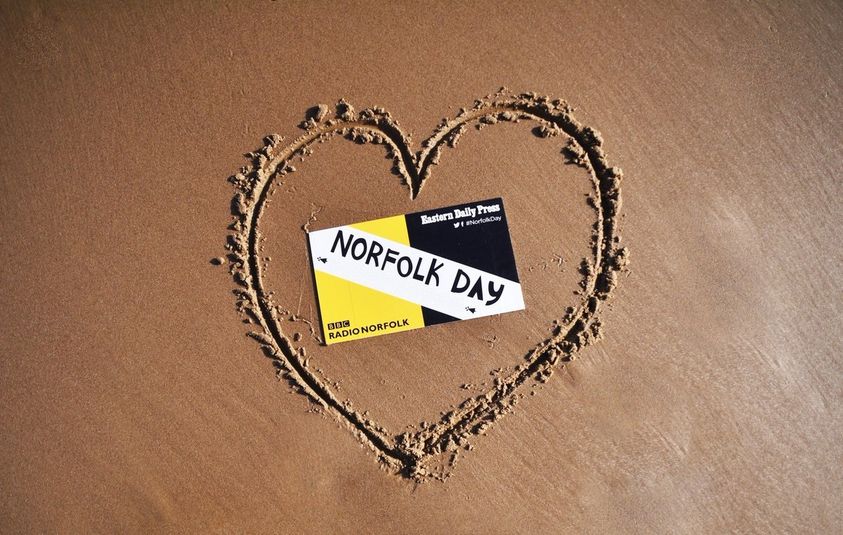
It's Norfolk Day

Since 2018, July 27th has been marked as Norfolk Day. Various people in various places have organised special events to celebrate our wonderful county. Bob and I love the place- but have never actually done anything on this day.

Cycle rides [too lazy], cribbage nights [cannot play] beach clean-ups [we live in the middle of the county] But I admire all those who are putting on fetes, and tea-parties, and craft fairs... 
The Women's Institute are doing lots of things [no WI in our village though] and others are dressing up as local heroes for the occasion.
But this year we have found something. It being Thursday, we planned to be in Norwich [Bob's at the Hospice in the afternoon] and I saw an ad for an event at the Maid's Head Hotel. I have always wanted an excuse to go in there!
So we have booked tickets for this talk...it ticks all the boxes [Norfolk, history, environmental and social issues, National Trust, tea and coffee - and it is free!]

Join us for this special talk to celebrate Norfolk Day ! Dr Rob Knee, in the guise of Sir Robert Hunter, will relate the remarkable life of Octavia Hill. In 1895, Octavia Hill co-founded the National Trust with Sir Robert and Canon Hardwicke Rawnsley.

Octavia was born in Wisbech and became a leading campaigner on social issues, many relating to improving the environment for the disadvantaged and to provide access for all to beautiful places. In 1912, Blakeney Point became one of the National Trusts first ever acquisitions.

I will report back...