I know that my good Buddhist friends follow the Noble Eightfold Path, but this is different. When we were at school, our Maths Teacher told us it was impossible to fold a piece of paper in half accurately more than seven times. As she pointed out, we would then have 128 layers of paper to contend with. Using an A4 sheet, the folded piece could have an area of around 3cm². A very thick postage stamp! But of course we tried, folding, and pressing down, and using different papers... A regular sheet of tissue was a little easier. We concluded that a very large sheet of very thin paper might do it. That 7-fold record has been beaten- but with a massive piece of paper which would reach from here to the village hall! Once I grew up, I found four particular folds useful - my MIL's sock fold [see Sox Before Marriage] and Martha Stewart's folds for towels, sheets and teeshirts. The tee shirt fold looks impressive in action, but I gave up on it because I didn't like its asymmetrical appearance on the shelf. So when I picked up The Folding Lady thinking it was an origami book, I was interested to see Sophie Liard's take on this process. The book is 255 pages long. Part one [pp 1-92] is Sophie's story, part 2 [pp 92-217] is The Folding Guide, part 3 [pp218-255] is Final Thoughts - inc. helpful links [including 6 lined pages for your notes]
Part One Sophie began her working life folding garments in a department store. And was hooked on the process. She explains that her main principle is "After Value" - which is the "positive feeling, reason for or result of, doing or buying something that is motivated by our own wants and needs, our goals and priorities, not what social media or advertising tell us will improve our lives forever" and "we get to find AfterValue in our homes by making a RESET of our space"
It takes her a lot of words to explain this! The bit that stuck with me was her comment that having an organised nappy changing area meant that if the baby had an 'explosion' she could deal with it in seconds and settle back to watching 'Game of Thrones'. I'm not sure her book is aimed at old grannies like me! She suggests drawing a chart to show which items/activities in your life have high or low AfterValue. Her high scores are for walking, reading and steak dinners, low value going to the gym or theme parks, eating sweets [she prefers chocolate]
A RESET [Recognise, Engage, Set-Up, Execute, Test] is when you reorganise a corner of your home [knicker drawer, kitchen, bathroom cabinet, whatever] to make it function more efficiently.
Having got hooked on folding she started putting videos on TikTok, got millions of followers, got an agent and a book deal - the rest is history.
Part Two. The Guide. You need to know three folds - the "thirds" [as per Martha Stewarts bath towels, and much of Marie Kondo's system] "half folds" and the "Ranger Roll" developed by the 75th Ranger Regiment of the US Army in the 1980s. The latter was to help men get their equipment neatly packed and ready for instant deployment.
Thirds - fold garment into three bottom to top, then into three sides to middle. That's it! Use it for towels, sheets, hankies, napkins - anything vaguely square or rectangular. Half - fold it in half, tuck in sleeves, and fold into thirds. Tee shirts, jeans or babyclothes.
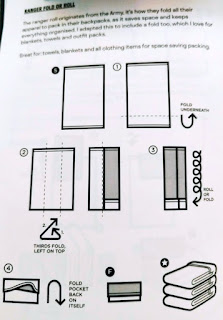
Ranger Roll - fold a small piece to the back [this will later form a 'pocket] Fold into thirds sides to middle. Roll - or fold- down. Fold pocket back on itself to hold shape together. Blankets. clothing, pants.Like Kondo, Liard talks about folding teeshirts in half and standing them on end so you can see them in the drawer. But her shirts fall over, Marie's are much more stable, because of the little gap left [see below]
I moved on from the clothing to the kitchen section. "Countertops are what I call an open space... where everything can be seen" She urges us to get rid of visible packaging "ultimately no branding is allowed on your countertops". I have failed there then - unless Tefal, Melitta and Magimix on my appliances is permitted.I do agree with her that Skubb storage boxes from IKEA are a good way of segregating socks/ pants/ vests etc in your undies drawer. But only if you have deep enough drawers. I have been using them since 2014, and they work fine in IKEA Malm, but not in other drawers.
Overall conclusion - not really a book that is useful for me. And despite what she says, I do not think this will give me 'AfterValue'
I give this one ** [there is too much repetition, not enough useful content]
Update: still hunting for a video tutorial of MIL's sock method!
 Overhyped and underwhelming. Jess went into the ball pond to find a magic red prize envelope. As far as we could tell, the cards inside all read "Sorry, no prize this time" or "You have won a free cup of coffee". Jess had the former, a number of grumpy children near us were saying "But Mum, I don't like coffee!" You could queue to be photographed with a real live character. But the line had about 30 people in it, no sign of 'character'. I asked nicely, and the assistant said yes of course Jess could be photographed in front of the cardboard cutouts.

 Then home, to make first a Father's Day Card for her Daddy, and second, a pointy hat! We used Grandma's sewing machine. And had a quick maths lesson- Jess learned to make a cone shape using a circle.