Showing posts sorted by relevance for query quaker tapestry. Sort by date Show all posts

Thursday, 18 April 2024

A Get Well Gift

Bob came home on Monday with a gift - he had been in Wymondham, and popped in a Charity Shop - where he found a book he thought I would like. I have blogged about the Quaker Tapestry before. Check out the website here. The Centre in Kendal sells embroidery kits. This book is a guide to the stitching, with a particular emphasis on the Quaker Stitch.

One Sunday in 1981, a twelve year old boy called Jonathan Stocks asked why he had to just do colouring with the younger children on a Sunday at the Quaker Meeting, Wasn't there something more interesting?  From this, Ann Wynn-Wilson developed the idea of the Quaker Tapestry. A piece [similar in idea to the Bayeux Tapestry 900 years before] work as a collaborative project, to tell the story of the Quakers, their faith, their history, their deeds... It took 15 years to produce, with 77 panels, and around 4000 people involved. Now you can see in on display in Kendal. Cumbria. It is a wonderful piece in a beautiful location.
The fabric used is a woollen fabric with a random warp producing a low key stripe. The weave and stripe provided a guide to keep lettering and buildings vertical. It is backed with calico, which carries the design for the picture and wording on the front.


Quaker Stitch was developed especially for the tapestry and is now recognised by the Royal School of Needlework
Quakers have always promoted gender equality- and one kit features a bicycling woman! My book shows how to recreate this piece, and personalise it.
There is also information [and an alphabet guide] for stitching your own words!
I have had such fun reading through this book, and I suspect some of the ideas may make their way into Collaborative Project #3. 
I have learned too, that the word crewel comes from the ancient word describing the curl of the staple of the wool. Crewel wool has a long staple, which is fine and can be strongly twisted.
I love this book!
Thank you Bob! And thanks too to everyone else who has posted kind Get Well Comments - my sore throat is improving [but I am grateful not to have any preaching commitments this weekend!]
This book gets a *****rating from me! 
I think it is wonderful too that the Quakers refer to themselves as The Society Of Friends. 


Sunday, 27 March 2011

A Pause In Lent #3

A Pause in Lent Floss

Isn’t it strange how things all seem connected ? I hadn’t thought about Malawi for ages, then…

Last week I met a Bishop who had worked in Malawi, a family whose son is currently doing mission work in Malawi – and Steph phoned to say she had found some Malawi currency in a drawer [she visited in 2008]

But the other subject that has been surrounding me like a cloud in the past couple of weeks is the whole topic of “People who settled in the USA to escape religious persecution” Sorry – that’s an awfully long definition, but I cannot come up with a tidy prĂ©cis.

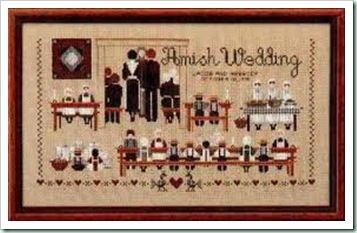
amish wedding

There’s been the whole Amish thing – the Plain Folk – that book, and the recent TV programme, and then ElizabethD blogging about her beautiful cross stitch “Amish Wedding”. And the soft colours on that piece reminded me of the fabulous Quaker Tapestry in Kendal

quaker tapestry fox

I have this postcard beside my desk as I work – George Fox, founder of the Quakers [or Society of Friends, as they prefer to be known] This term I have spent every Wednesday working at a school less than 15 minutes away from GF’s birthplace.

The Quakers settled in Pennsylvania – and then on Thursday night, I listened to the bluegrass music and thought of those who settled in the Appalachians, and how the English folk music brought with them had contributed so much to the musical heritage of that region.

I have found myself comparing and contrasting these two groups, [great websites here and here btw] and have concluded that in many ways the Amish way of life is summed up by the word Simplicity, and the Quaker faith by Listening.

And in many ways, I do want to live more simply, and listen more.

One of my favourite Fox quotes is “Be still and cool in thy own mind and spirit” I know I need to work harder at being still, and keeping cool!

BUT - and here is the thing – as much as I respect these people, and would not in any way wish to judge their lifestyles, in this past week, I have seen the aspects which just would not work for me personally.

Simplicity is great- one of my favourite magazines is called ‘real Simple’. But unlike the Amish, I have embraced modern technology, and I want to use electricity, computers, telephones, electronic sewing machines and cars. In the right context, these things have so much potential to bless others, and to make life more comfortable. Of themselves, these things are not sinful. I’m just too ‘techie’ to be Amish [and I’m certainly not submissive enough]

quaker prayer meeting

Listening is fine – we all need to do more of that. But having heard God’s voice, we need to go and act on it. Now I am not saying Quakers don’t act - historically, they have a rich heritage of social action [Elizabeth Fry with the prison reforms, Sophia Sturge with her anti-slavery campaign, war service in the Ambulance Corps etc] However I am a get-up-and-go-girl, the consummate multi-tasker. I really struggle to ‘just sit there’. So I can’t join the Friends either.

…but this past week, the main word has been HOLINESS. I have kept coming back to the need for my own personal holiness, being more like Jesus. I suppose this was the inevitable conclusion of my reflections last week about spending more time thinking about Him.

wwjdIt isn’t enough just to wear a WWJD bracelet [although I frequently do]

Having asked myself the question, I need to act on it, and act like He would in each situation.


An old hymn about the importance of seeking holiness – and two phrases in it which bring me back to Amish and Quakers again…

Take time to be holy, speak oft with thy Lord;
Abide in Him always, and feed on His Word.
Make friends of God’s children, help those who are weak,
Forgetting in nothing His blessing to seek.

Take time to be holy, the world rushes on;
Spend much time in secret, with Jesus alone.
By looking to Jesus, like Him thou shalt be;
Thy friends in thy conduct His likeness shall see.

Take time to be holy, let Him be thy Guide;
And run not before Him, whatever betide.
In joy or in sorrow, still follow the Lord,
And, looking to Jesus, still trust in His Word.

Take time to be holy, be calm in thy soul,
Each thought and each motive beneath His control.
Thus led by His Spirit to fountains of love,
Thou soon shalt be fitted for service above.

[I am certainly not there yet, but I am working on it…]

Saturday, 29 June 2019

Threads Of Life

I heard an extract of "Threads Of Life- A history of the world through the eye of a needle" on Radio 4, when it was Book of the Week a couple of months ago. So I ordered it from the library. Clare Hunter is a Scottish textile artist, and this is her first book.
She has divided her book into 16 chapters, with thematic titles like Captivity, Connection, Community, Power, Place, Protect, Identity, Loss etc.
There is much detail of various pieces of stitched work throughout history, and of how many women [and fewer men] have used the language of sewing to make their voices heard, across the world.
WARNING -I was so looking forward to this book -but found it deeply unsatisfying on a number of levels. If you have reserved it at the library [I have to get this copy back promptly, there is apparently a queue of readers awaiting it] then please do not read my review, as I don't want to put you off, you might love it.
HERE'S MY REVIEW- The book is very much the author's story, she has travelled the world with her needle, and so many chapters are her anecdotes about meeting Aborigine women, and Chinese ladies etc. Furthermore, she is based in Scotland - so in her discussion of Mary Queen of Scots, she laments that there is little of the royal embroidery to see in Scotland - neglecting to mention the V&A collection, or the Oxburgh Collection in Norfolk - she writes as if there are virtually no examples extant anywhere. 
Whilst she has covered a lot of ground in her book about "the social, emotional and political influence of sewing" [her description] I was really disappointed that apart from passing references to medieval nuns and the Bible Quilts of American slaves, the huge contribution of the Christian church to needlecraft has been almost completely overlooked [apart from a few rather negative examples of misguided missionaries]
Where is any mention of the great Quaker Tapestry, which gave the world a new crewel stitch, now recognised world-wide?
Where are George Mueller's Bristol Orphans, learning their special redwork embroidery, in order to prepare them for a trade when they grew up?
Or Elizabeth Fry, visiting the women prisoners bound for transportation to Australia, giving each a bag of fabric, needles and thread - so they could stitch a quilt on the long voyage [to use for warmth, or sell, or use as proof of skill, once they got to the Antipodes]?
The woman in Woolwich who set up 4 sewing machines in her church hall, to teach lonely, frightened Somali refugees how to sew, back in the 1990s [sorry, I can't recall her name] and it became a significant support group.
I could list loads more examples - but you get my point.
But that's just me - I see my own stitching gifts as God-given, and to be used to bless others. I'd hoped she might have picked that idea up somewhere from her research.
Here are my general gripes - The very clear lack of proper proofreading. This is her first book, and I think one of the Editors at Hodder/Hachette should have made a lot more of an effort here.
Spelling mistakes - miniscule and sweat pea to mention just two
Basic errors - reference to "the eight corners of a hexagon" and "Pythagoras' Theory"
And as for historical inaccuracies - [many of the Amazon reviews cite her significant errors about the Bayeaux Tapestry] she is 70 years early with the Foundling Hospital, the 17th/18th/19th centuries get very blurred [eg saying 18th century when she means 1800s] and her first reference to the Suffragettes talks about their red, white and green colours.
I got to the point where the number of mistakes over things I did know about made me doubt the information she was giving in her stories of needlework I didn't know about. My frequent mutterings about "that's not right" and "rubbish!" definitely disturbed Bob's bedtime reading.
Because the chapters are thematic rather than chronological, it is hard to go back and check up on things - an index would have really helped here.
But the biggest fault ?
THERE ARE NO ILLUSTRATIONS!!!
How are we meant to envisage things when we do not really know what they are, and what they look like? Hunter does her best with descriptive language. In 100 words she carefully explains an antimacassar stitched by Margaret MacDonald [wife of Charles Rennie Mackintosh] I sketched my impression of what this would look like from her words. Then I googled an image of it- and my drawing was completely wrong. Illustrations would really make this book come alive - and be very useful for those of us who cannot immediately call to mind what "Cretan stitch" is. I have deliberately avoided putting pictures in this post, which I think makes it less interesting than it might be.
This lady is clearly a gifted textile worker, and feels strongly that stitchery is a silent language which should be used to make the voices of the people heard more loudly, and to keep telling their stories after they have passed on. I admire her for that. But sadly I found this this book a real let-down. 
So it only gets **