The word sampler is derived from the French examplair, meaning a pattern to work by, copy or emulate. It derives fromt he Latin exemplum. The earliest surviving needlework samplers, worked in double running stitch and pattern darning are those found in Medieval Egyptian burial grounds. European embroideries were almost certainly influenced by the patterns thereon - especially the lozenge shape and letter forms S and X. During the Renaissance in Europe, there was a great revival of interest in decoration, many women took up needlework to beautify garments and furnishings. There were no printed patterns then, designs passed from hand to hand - filtering through from the Middle East to the Continent.
The recording of patterns, motifs and lettering was essential for future use, and thus was the 'sampler' created. Ideas were shared between friends and immediately stitched to samplers before they were forgotten. They filled the vacant spaces, often in haphazard and random ways - experiments with new stitches, colours and threads before proceeding to a major piece of work. Samplers became popular in England from the 16th Century - and were often used to record family evenings [births, weddings etc.] They were precious, and often bequeathed in wills. Blackwork - using a single colour was popular, and when Henry married Katherine of Aragon it was named Spanish Work [until the Royal Divorce] Double running stitch was named Holbein stitch - the court painter frequently portrayed characters wearing garments trimmed with this work.
Kirsten and I will be carrying on this tradition with our Cross Country Collaboration - choosing random sections of our canvas to develop our skills and share ideas. K suggested the cross stitch idea, never having tried it till last year with the Postcard Project. I've been doing it since before the girls were born. But already I am learning things, and K's ideas are sending me off in new directions which is really exciting.
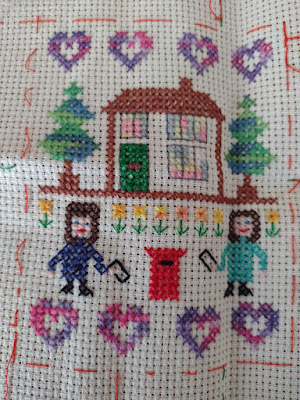 Her first piece or the CCC arrived at the weekend - it is a proper example of what should be in a sampler. She has drawn the two of us, either side of the postbox, about to mail our little packets of stitching, There are trees, flowers, a house, and hearts.
 Rather than introducing lots of new threads, K had the brilliant idea of using multi-colour floss as a way of providing interest to the sections. The trees are different shades of green, the variegated pastels in the window pane look like reflected light, the petals on the flowers are shaded, not uniform, and those hearts go from pale pink through to deep mauve. What an effective and efficient use of threads!
This idea had never occurred to me before.
We never disclose what we are stitching - opening the packet is always a surprise - but Kirsten had mentioned buying the variegated threads. And I picked up on that thought before I began my February stitching.
I love these two cheerful women [she sewed it before my haircut] the very British postbox, and the friendly hearts. And the English house with its tidy trees and neat row of flowers. What a brilliant start to the project.
And my 'flat gift' was really cool. I thought it was a pen- but no, it is a neat little pair of scissors which make their own case. Lovely for my bag and stitching on the go...Thanks K!