Thursday, 12 January 2017

Oh My Darling, Oh My Dahling, Oh My Dhaling, Clementine...

My banting also seems to include dhal-ing. Lentils are a very good part of your diet if you want to eat foods with a low Glycaemic Load. GL is a measure that takes into account the amount of carbohydrate in a portion of food together with how quickly it raises blood glucose levels. Dhal, made from lentils, is a nourishing, sustaining food - as people in the Indian Sub Continent have known forever.
Do not confuse Dhal with Dahl! The first is the lentil dish, the second is the Norwegian surname of Roald [the writer] and his granddaughter Sophie [the cook] She has actually published a recipe called Sophie's Dhal. The clementine** is simply there so you can look at the pictures and sing the song!
On Monday I cooked up a batch of green lentils and kept them in the fridge. That way I could sprinkle some into a salad and serve the remainder with chicken breasts and green beans for our evening meal. I have green lentils, red lentils and yellow split peas in the pantry [all dried] My new Fresh India Cookbook has a number of lentil recipes - as does the Ottolenghi 'Plenty More' book which I gave Bob.
Did you know that the word lens comes from the double convex/circular shape of the lentil?
In Italy and Hungary they eat lentils on New Years Eve - their round shape is reminiscent of coins, and symbolises hope for a prosperous year ahead.
Jewish people eat lentils as part of their mourning tradition - for them, the shape is symbolic of the cycle of birth, life and death.
**I just realised whilst singing 'Clementine' to myself that I took a photograph of "Herring boxes without topses" last week.
In a cavern, in a canyon,
Excavating for a mine,
Lived a miner, forty-niner
And his daughter Clementine


Oh my Darling, Oh my Darling,
Oh my Darling Clementine.
You are lost and gone forever,
Dreadful sorry, Clementine.


Light she was and like a fairy,
And her shoes were number nine
Herring boxes without topses
Did for shoes for Clementine.


[In another interesting plot twist, I have just discovered a friend here in Ferndown is actually a descendant of Mr Banting!!]

Wednesday, 11 January 2017

Thank You And Goodnight!

Well,  today anyway... I was in the classroom by 8.05 and left,  after completing a mountain of marking,  at 16.50. I was on playground duty at break,  and spent half my 50 minute lunch break marking and preparing for the afternoon.  But they were a lovely class,  colleagues  were supportive,  and everything went surprisingly well. So this is a good sort of exhaustion. So exciting to realise I CAN still do it,  and teaching still gives me a buzz.  Thank you to everyone who sent me such kind words of encouragement. 

Feeling Classy...

No time to blog today.  For the first time since December 2014, I shall be back teaching in a classroom.  Excited and a little apprehensive.  I will report later...  

Tuesday, 10 January 2017

Underground Adventure

We finally caught up with Alexander Armstrong and Michael Scott and their latest TV series about Italy's Hidden Cities [Here] I really enjoyed the one they did from Rome last year, and was surprised that the reviews of this one have been quite so sniffy. Last week's episode featured Naples,   and we have  Venice and Florence yet to come. 
Scott is from University of Warwick  [my Alma Mater] and I think he is fun to listen to.  I don't think the programme is meant to be a heavy historical lecture,  and so I'm happy to be gently entertained.  Maybe it's because I just enjoy random trivia,  and odd little facts about abandoned subterranean scooters, and  bottles of hair lotion  fascinate me.  I have learned an Italian Phrase,  noi vive ,  we're alive! Have you watched this series,  what do you think?  Or do you find anything with AA in it to be Pointless?  

Monday, 9 January 2017

Time And Tide...

On the last day of our holiday we were determined to get out and do something interesting. So we drove to Yarmouth and visited the wonderful Time And Tide Museum.
This is located within one of the old curing houses, where the herring were brought to be cured. The Museum tells the story of Yarmouth - but cleverly maintains the original features of the building, so you can look up and see 1000s of herring curing on racks up in the roof space [these are replicas- hung there by teams of volunteer Boy Scouts] and occasionally you come across a brine tank, or stack of crans [the baskets in which the catch was brought ashore] 
Many of the rooms are still redolent with the smell of fish - which adds to the atmosphere. This is a genuine smell- the industry only stopped in the 70s - unlike the fake 'old' smell you find at Yorvik and other museums. 
There is far too much for one post - it was the sort of place where you found something new round every corner. 
As well as the permanent display about the history of the town and the fishing industry, there are temporary exhibitions- currently one about the 1950s. But you begin by entering the Yarmouth Rows. Until the 19th century, building was only permitted within the mediaeval town walls. The limited space dictated that houses were built as closely together as possible, which led to the development of The Rows. Unique to Great Yarmouth, these were a network of 145 very narrow  parallel streets. Charles Dickens said of them: "A Row is a long, narrow lane or alley quite straight, or as nearly as maybe, with houses on each side, both of which you can sometimes touch at once with the finger tips of each hand, by stretching out your arms to their full extent." The Rows were all given names derived from local characters or prominent buildings. 'Kitty Witches' running from King Street to Middlegate Street, was the narrowest row at just 27 inches wide in some parts. Sadly many were destroyed in WW2, or in the postwar clearances - but here in the Museum is a wonderful reconstruction.
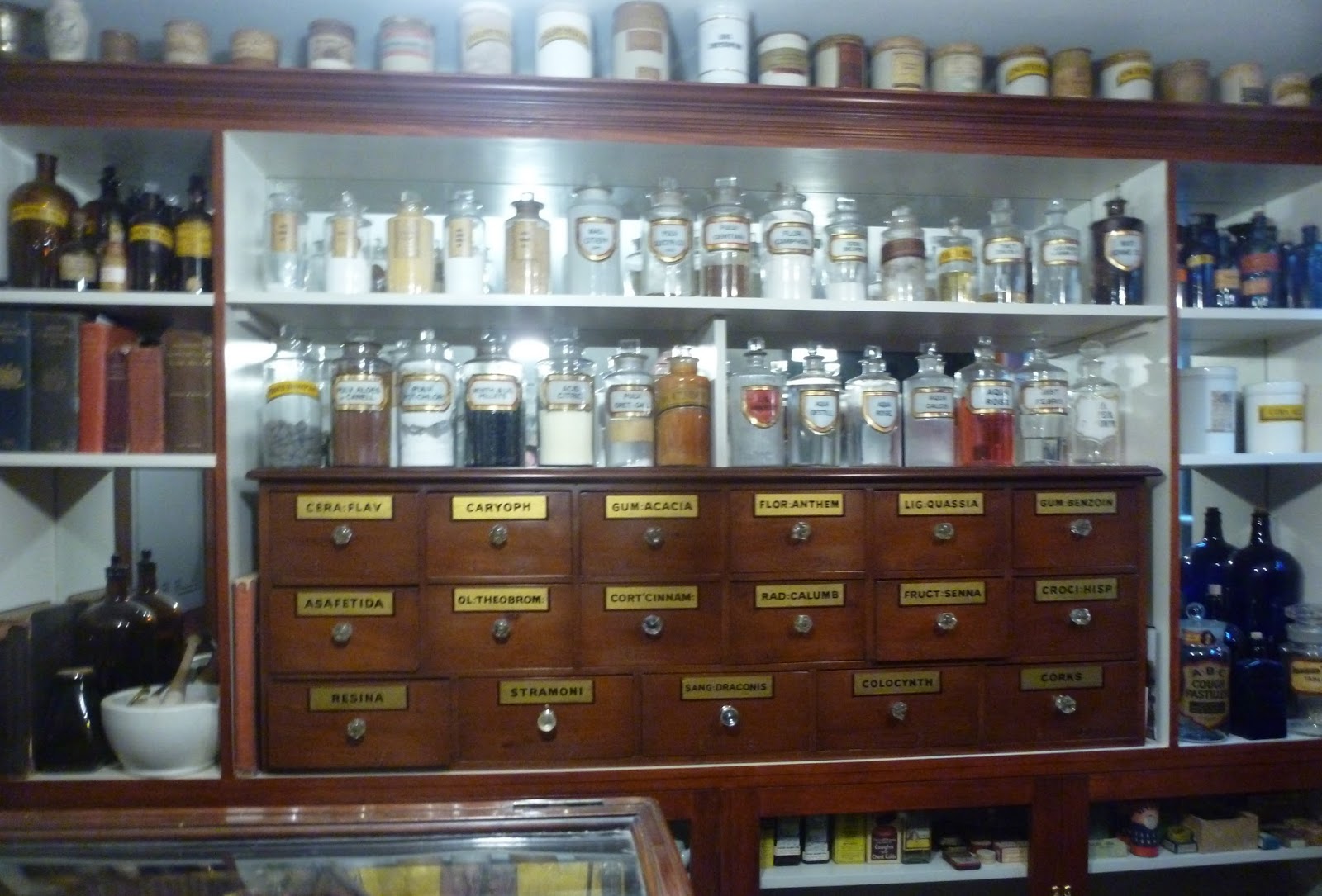
Shops and homes nestle together - and you can see a mother rocking the crib, an old seaman on a bench, his net hung by the fire to be mended, a chemist's shop and much more. I loved the goods on display in the chemists - maybe the celery pills might help my knee? Not so sure about the 'occasional pills for ladies' [for period pains I suppose] made of steel, penny-royal and bitter apple.

After the Rows, we went across the courtyard, where there were some boats moored [and a play one for the children to clamber over] into the area which focussed on the fishermen and the herring.

It was a hard life, out in all weathers working long hours in the wet and cold, to bring home the food. The whole process of curing used techniques learned from the Dutch [initial treatment of the fish on board when they were caught] and the Scots [smoking the herring once they were brought ashore] Many folk from both these nations brought their skills to Yarmouth, and signs of their influence remain in the town.


The use of life size models - such as the man standing in the brining tank - gave you a clear idea of what it was like. The displays were set out with clear information panels, and there were optional audio guides [adult or child] explaining everything.
The Scottish girls were renowned for their speed and efficiency at gutting the fish, but whilst waiting for the boats to return, they could often be seen sitting round the town chatting and knitting.
"Whan dey wir nae herring in, dan wid sit on da swills an knit"
I was surprised to discover that much of the herring brought in at Yarmouth was destined for export - the best quality fish destined for Italy. They were very carefully packed in their boxes, head to tail. In 1888 the Italian Consulate actually prepared a document about this, stating that "The Italians are an artistic people, and like things not only to be good, but to look pretty" 
Herring boxes were stencilled with the names of the company, and the lids carefully nailed down on the fish - 40 in each box.  The logo of the museum shows that space efficient head to tail packing pattern. 
 I felt overcome with the urge to do some craft - but couldn't decide whether I wanted to knit a Scottish Hap [as per Kate Davies' fabulous designs] or embroider some little fishes! I was amused by the person who complained on the Museum Website comments page, that some of the rooms smelled [what did she expect in a curing works?]
There were other rooms to see and lots more to learn - but I shall save that for another day. This is a great museum and worth visiting [and there is a convenient car park right opposite. Allow yourself at least an hour on your ticket]


Sunday, 8 January 2017

A Different Way

We're in the season of Epiphany, when it is traditional to remember the wise men who came to visit the baby Jesus. The Bible account records that after they had seen the child, God warned them in a dream not to report back to King Herod - so they returned home by a different way.
This phrase has challenged me a lot in the past week, since I heard it read last Sunday in church in Norfolk.
Having encountered Jesus, their lives were changed - forever. They understood things which they had never grasped before. The dictionary definition of the word Epiphany is; 
A manifestation or perception of the essential nature or meaning of something, an intuitive grasp of reality through something simple and striking, an illuminating discovery, or realization.
They went home by a different way. OK, I know that means 'by another route', but I suspect it also meant that ever afterwards, maybe they saw life in a different way, and their behaviour was changed because of their Epiphany.
For me, personally, I believe this applies in two ways - when I first truly encountered Jesus and became a Christian, my life was turned round, and I started living in a different way. But also, my daily experiences of God's grace should also affect the way I think and act. I need to be constantly re-evaluating things, asking WWJD? 
Sainsbury's tagline 'Our values make us different' applies just as much to those of us who claim to be walking the path of faith s it does to supermarket operations. 
Even with my strong Nonconformist heritage, it is not always easy to be different - sometimes it is tempting to just shut up and blend in with the crowd.
But this year, 
I want to have the courage to speak out for what is true and just
I want to have the strength to stop and help those in need, not pass by on the other side
I want to have the faith to say 'this is wrong, and we can work to change it for the better'
I want to have the hope that believes things will be different
and above all
I want to have the love that says 'OK you are different from me in some way - but I still care about you, and want the best for you'


Saturday, 7 January 2017

More Paneer In 'Ere

They have had to withdraw this ad, after complaints to the ASA. But this post is not about VENeer, it's about PANeer, the Indian cheese. I had never eaten this, not being a cheese eater. Liz suggested I try it, because it is very similar to cottage cheese, which I can eat. For Christmas she'd requested "Fresh India" by Meera Sodha, the follow up to her first book "Made in India". But Liz ended up with two copies, so I said I would keep the one I'd bought for her, and gave her an alternative gift instead. 130 quick, easy and delicious vegetarian dishes for everyday says the blurb on Ms Sodha's book.
On Thursday evening, I made Meera's Paneer Butter Masala - Jon had made this one in London earlier in the week, and they had enjoyed it. It was delicious! not too spicy but a really good flavour.
It is always satisfying when my attempt looks very like the one in the book!
In case you are wondering, this is Bob's portion, served with regular rice, but I did low-carb cauliflower rice with mine.
The recipe serves 4 [I halved it] and you need a heavy lidded frying pan.

rapeseed oil
500g paneer cut into 2cm cubes
3 tbsp unsalted butter
1 onion finely chopped
4cm ginger, peeled and grated
6 cloves of garlic, crushed
800g tomato passata [I blitzed a can of chopped toms]
1 tbsp fenugreek leaves [sainsburys had none, I used 1tsp ground f. instead]
1 tsp cinnamon
¼ tsp ground cloves
½tsp chilli powder
2 tbsp honey
1½ tsp salt
250g peas [fresh, or defrsted]
100ml double cream [none in house, I squirted some from can]
handful of toasted flaked almonds

  1. heat 1tbsp oil, fry the paneer cubes till golden on all sides,  put on a plate
  2. in same pan melt butter, cook onion for 10 mins
  3. add ginger and garlic, stir fry 5 mins, then stir in passata
  4. cover with lid, cook 12-15 mins till reduced
  5. stir in all spices, honey and salt, add fried paneer, replace lid, cook 5 mins.
  6. add peas and cream, cook further 5 mis
  7. scatter with almonds, [optional, drizzle with more cream]
  8. serve with steamed basmati rice.


Friday, 6 January 2017

Out With The Bunting, On With The Banting!

Back from Norfolk, and busy with the job of taking down the decorations. Like my bunting [which I made in 2012 according to the handstitched label]
The garland on the staircase came down too, but there was a slight disaster
The little wooden motto which said 'Have Faith' broke.  It came with one saying 'Peace on Earth'  - from a Poundshop in 2010. 
I am obsessive about labelling the date of acquisition of decorations, no idea why.
But anyway, it snapped.
Have Faith has become Have Fat
It's a sign!! I know I need to lose weight - the GP and Physio both indicated that my knee pains are exacerbated by the excess pounds I have been carrying since moving somewhere beset by regular Church Lunches and Cream Teas.
Did you know that the victorians referred to dieting as "Banting" ? William Banting [1797-1878] was a very overweight undertaker in London, who went to his doctor because he was conscious that his size was making him ill.
His medic put him on a strict high protein/low carb regime.
Breakfast, 9am: 6oz of either beef, mutton, kidneys, broiled fish, bacon or cold meat of any kind except pork or veal; 9oz of tea or coffee without milk or sugar; a little biscuit or 1oz of dry toast.
Lunch, 2pm: 5-6 oz of any fish except salmon, herrings or eels, or any meat except pork or veal; any vegetable except potato, parsnip or beetroot, turnip or carrot; 1oz of dry toast; fruit out of a pudding, not sweetened; any kind of poultry or game; 2-3 glasses of good claret, sherry or Madeira. Champagne, port and beer are forbidden.
Tea, 6pm: 2-3oz of cooked fruit, a rusk or two, tea without milk or sugar.

Supper, 9pm: 3-4oz of meat or fish similar to lunch. For nightcap, if required, a tumbler of grog (gin, whisky or brandy, without sugar) or a glass or two of claret or sherry."
It was so successful [he shed 3 stone in a year] that Banting publicised this, with a "Letter On Corpulence" sent copies to the hospitals and did all he could to help those afflicted with obesity. 
The diet is very like the Atkins Diet - high protein/low carb, but unlike Dr A, Mr B did not seek to profit from his discovery.
The word 'banting' meaning 'dieting' remained in the OED until the 1960s.
I have decided not to go on a very strict diet regime. A couple of trips away this month will mean there are some days wen I will not be able to diet easily, as others will be preparing/providing my food. But I am trying to cut down on bread, cakes, pasta and puddings. That at least is a start...
I am certainly not planning on following the Banting diet- I couldn't face mutton and kidneys for breakfast, and I certainly couldn't manage all that alcohol.

Thursday, 5 January 2017

Wildlife Alert ; A Croc Has Been Spotted On The Marshes!

Last Friday Bob declared himself free of the virus, so we decided to go and see the sea. We drove to Burnham Deepdale and began walking along the raised path across the marshes. We saw nothing except fog in all directions. Bob was glad of his super new Headlight Hat [Christmas gift from Adrian and Marion] and I loved my new SeaSalt jacket [a joint gift from the girls] 

We heard lots of geese, and at one point, a woman coming the other way called out "Look!" and pointed upwards. We, and her companion, looked up. There was a patch of blue in the sky, and across it flew a skein of dozens of geese in a V formation, then disappeared into the clouds again. We walked for quite a while, there were others on the path - huntsmen with rifles, a middle-aged jogger in unflattering shorts, and a cheerful family spanning three generations [the youngest clearly feeling she had walked quite far enough, thank you] 
There was a small, battered rowing boat, and the children had fun playing in it [you can just pick out the Grandma's bright blue jacket]
And a larger barge - is it deserted? or does someone live there? There were no lights on, and no curl of smoke from the little chimney, and the door was securely padlocked. I enjoyed myself splashing in the puddles, just because I could. Oh Rosie, when you are a little bit older, you and Gran will have such fun together...
But we did see a croc. Just the one...
Such sightings always intrigue me - how did they come to lose just one shoe? 
And is there a damp footed Norfolk Cinderella hanging about somewhere waiting for her Handsome Prince?

Wednesday, 4 January 2017

Dark Star

We went to see Rogue One. It was that or Eddie Redmayne in the HP spin off, and I said I would prefer the Star Wars saga. This is [if I have got my head round it] the 4th one, chronologically - set immediately before the original Star Wars - A New Hope [1977]
Vue Cinemas Norwich is an excellent venue , you can buy tickets, and prebook seats online, and you get free parking.
You pick up tickets very quickly from the machine on arrival - BUT then you have to join the massive regular ticket queue to get your car park ticket stamped and qualify for free parking. Bad planning imho!
But back to the film - good points

  1. good acting, great special effects
  2. lots of reference, obvious and oblique, to the other films in the SW oeuvre.
weak points
  1. very dark - both in terms of the way the set was lit - in places it was gloomier than BBC's Jamaica Inn!! - and also in terms of plot.
  2. Unnecessarily high body count, I thought
  3. That CGI Peter Cushing was rather strange
two other things
WHY haven't we got more females in important roles this film? There were 5 females who had speaking parts in the entire film, and possibly [not sure, their hoods were up] a few peasants in the market who were not blokes. I guess that they would have to redesign the Storm Trooper Uniform to accommodate boobs, if there were going to be 'bad' girls. But we could certainly do with more feisty rebel 'good' girls.
FINALLY I spent a lot of the film feeling sad about Carrie Fisher. 

I thought it was infinitely better than Revenge of the Sith.
But I will not give 5 stars without either Harrison Ford, Euan McGregor or Alec Guinness on the cast list
I cannot give 3½stars out of five, so will be generous and say ****

... HOPE is a good an appropriate theme, for the film, and for this New Year 

Tuesday, 3 January 2017

Britches, Bandanas And A Sinister Badger


It would not feel like a proper Norfolk trip if it didn't involve some mending and this week has been no exception.  I fixed Jon's trousers and mended Rosie's badger puppet.  That included transferring the squeaker from right to left paw for the benefit of the left-handers in the family. This  makes him truly sinister. 

My final sewing was a request from Liz.  She gave me one of Jon's old shirts and asked for some bandana bibs for Rosie   Using a scrap of blue flannel  and a pack of poppers [hammered in place]  from John Lewis,  l made these using the great pattern here. 
These never got into the end of year craft round up,  but never mind. 
I don't know what you think,  but the baby is certainly drooling over them! 

Monday, 2 January 2017

Sunday, 1 January 2017

Hope Does Not Disappoint Us

Back in October I was given a M&S 'grow an amaryllis kit' by the good ladies of the WWDP in Goring, Sussex. Well you know me, I struggle with growing-cress-on-a-flannel. But I flowed the instructions, planted it and in time a green shoot sprung up with first one then 4 buds around the top. I forgot to photograph it then - but here is a similar picture I found on the net. "It would be nice if it flowered for Christmas" I said to Bob on Sunday 18th December as we ate breakfast before church. Three hours later, we returned after the brilliant All-Age Nativity Service led by Miriam our Youth Minister, to find this...
One bud had completely opened, in the space of just 3 hours. Utterly stunning. Bob took some pictures for me whilst I prepared lunch.


On Christmas Morning, we awoke to find two more blossoms open - they had been buds when we went to the Midnight Carols a few hours earlier. We came away to Norfolk wondering if #4 would bloom in our absence.
Somehow these blossoms have really challenged me. When I first planted them, I was in a pretty despondent mood about life- Brexit, Trump, Aleppo... and loads more things seemed to be going so very wrong. And I had very little hope that this dead looking bulb in its pot of dull brown compost would come to anything.
And I was so totally wrong - these beautiful, glorious blooms bear witness to what loveliness can grow from apparently lifeless beginnings, even in the hands of a non gardener like myself. My hope was pretty feeble, but in the end I was not disappointed - in fact I was overwhelmed. There's a part of Romans chapter 5 where the Apostle Paul writes 
We know that trouble produces endurance, endurance brings God's approval, and his approval creates hope. This hope does not disappoint us, for God has poured out his love into our hearts by means of the Holy Spirit, who is God's gift to us.
Find a Bible and read Romans 5 - and have hope. We start this new year in a world full of troubles - but I believe God will sort it out in his time, and I can trust Him to see me through each day. 
As Paul said in 1 Corinthians 13
'faith, hope and love remain' 
may your New Year be blessed with all three virtues - and especially the greatest of these, which is love.


Saturday, 31 December 2016


December Doings, Done And Dusted

My final Craft Round Up of the year. Here it is
All Christmassy - and all Church related

  1. my remade 'Sunday Candle' reminding me to be a light for Jesus in my community
  2. the jigsaw gift tags I made with children at the Craft Fair
  3. the little woolly hats made with adults at the Craft Fair
  4. the various nativity costumes and headgear - my tutorial for this has now be repinned over 2K times on Pinterest. I am amazed
  5. my church biscuits- and all the other cooking stuff
  6. the dining room floor, showing evidence of all this craftiness [now vacuumed and shampooed]
  7. Lelaine and Rebecca dancing at the Carol service
  8. The UCF Christmas Tree in the Festival at St Martins
  9. One of the dance skirts
And finally, a collage of the whole year's output. I suspect there are a few crafty bits which have escaped the camera - but nevertheless I feel happy with this lot. I may not be in paid employment at the moment, but nobody could say I am sitting around twiddling my thumbs! I am not sure which project has been the most satisfying. I've loved making garments for others [especially Rosie], and greetings cards for friends, and home renovations...but I suspect 2016 will be marked at the year in which I actually got to exhibit some of my work in a pukka textiles exhibition in Norwich Cathedral. Now I really can call myself a craftswoman!


Friday, 30 December 2016

How To Be A Smarter Trolley Dolly

Many people resolve to spend less in the New Year.  Here's a handy little infographic to help you improve your supermarket spending habits [if you can't read this,  go to the site here

Thursday, 29 December 2016

Q Is For Quarantine

Unfortunately the family has been hit by sickness this week, right, left and centre. Coughs, asthma, DIY injuries - and worst of all, Steph and Bob have been laid low by the novovirus.
Plans for weekend get-togethers are all on hold, and I am praying that Rosie escapes anything nasty. It is hard enough being ill in your 30s or 60s - worse when your age is still measured in months not years.
Much as I admire Florence Nightingale, the only traits we truly share are those of mathematics enthusiasts and fondness for pie charts. I am not a particularly good sick nurse. But I love them and I do my best [ 3am is not the optimum time for me to dispense sickbowls, glasses of water and TLC] I am thinking of getting out the sewing machine and running up a costume for myself.
These Plague Doctor Costumes look scary but there was a lot of sense behind them, at a time when germs and infection were not properly understood. In the 17th century, it was believed that illness was transmitted by bad smells [the miasma theory] a French physician, Charles De Lorme designed this outfit.
The hat is simply the badge of the physician - you knew where someone fitted into society by their headgear - royalty had crowns, soldiers helmets, nuns wore coifs, and medics had silk hats.
The robe is sewn from leather or oilcloth to make it waterproof so nasty liquids, blood or whatever could not leach through onto the doctors skin. Underneath they usually wore a simple cotton robe.
The cane was used to indicate things or move clothing so that the doctor did not have to touch the patient and could keep his distance.
The doctor wore gloves for his hands, round spectacles to protect his eyes - and most importantly the beaked mask. This was made of bone, and the tip was a primitive respirator, filled with mint, spices and aromatics, camphor, dried roses and carnations, and a vinegar sponge. Lorme wrote that the mask had a "nose half a foot long, shaped like a beak, filled with perfume with only two holes, one on each side near the nostrils, but that can suffice to breathe and to carry along with the air one breathes the impression of the drugs enclosed further along in the beak"  A poem of the time says
As may be seen on picture here,
In Rome the doctors do appear,
When to their patients they are called,
In places by the plague appalled,
Their hats and cloaks, of fashion new,
Are made of oilcloth, dark of hue,
Their caps with glasses are designed,
Their bills with antidotes all lined,
That foulsome air may do no harm,
Nor cause the doctor man alarm,
The staff in hand must serve to show
Their noble trade where'er they go
The sight of a man like this [always men!] on the streets put the fear of death into people [understandably] and he was often nicknamed 'Dr Beaky'. Nowadays men [and women] put on HazMat suits - which embody many of the same principles [waterproof, respirator, eye protection, gloves etc]
Getting back to quarantine - the word comes from 'quarantine sanitaire' - the enforced 40 days of isolation of a ship before passengers could go ashore during the time of the Black Death.
In the system of maritime signal flags, plain yellow indicated the letter Q - hence this choice of colour for a warning flag. Nowadays ships fly a black and yellow flag if there is disease on board, and a plain yellow flag indicates they believe themselves free of illness and are requesting an inspection and clearance to disembark.
The wisdom of separation during illness has been recognised since Old Testament times [see the book of Leviticus] and the  people of Eyam back in 1665 probably saved many lives by their self sacrificial actions. Typhoid Mary, however went about spreading germs willy-nilly [not that I am happy about her subsequent treatment by the NY authorities]

For lots of different 2016 has not been the best year - both in the world outside, and here inside the family. But perhaps when we re-emerge in 2017, things will look brighter. 
Q may be for Quarantine - but it is also the beginning of a long queue of other words. In the year ahead, perhaps I should 
  • avoid questionable quackery
  • shun quaking, quailing and quandraries
  • admire quiet queenliness
  • maybe eat quahogs, quiches and quenelles [or not!]
  • prefer quilting to quibbling or quarrelling
  • quaff quinine when queasy
  • watch quizzes like QI [but not Question of Sport]
  • maintain a quintessentially quotidian blog

What is your best Q word? I do hope that you and your families have kept well over this festive season.


Wednesday, 28 December 2016

Biker Babes

One of the loveliest thing to happen this year has been reconnecting with my cousin Miriam in Australia.  Looking through a box of  Dad's old photos,  I found a note of my ten Oz cousins, and the names of their spouses etc. Although M is on her own  now,  she has kept her rather unusual surname, and typing it into Facebook revealed a picture that was clearly Miriam and my Auntie Jean [now a sprightly widow in her 90s] M wanted to know if that was her on the back of my Dad's bike,  nearly 60 years ago. No, that's cousin Oriel,  now a grandma up in Yorkshire! Dad loved his various motorbikes, and until I came along,  Mum rode pillion.  As I did, she had her own scooter in her 20s. 
This week  I have been reading about two intrepid females who rode/ride motorbikes 
Doris Halsall,  now 96, was a wartime despatch  rider. You can read her full story here on the wonderful Spitalfields Life blog. During WW2  she rode all over the place, doing her bit for the War Effort. 
The second motorbiker is Isabelle Kydd, and I read her story on the BBC website magazine pages here She works on a voluntary basis, travelling all over the country delivering supplies of blood, surgical tools and more to hospitals everywhere, saving lives and enabling operations. 
My admiration for these two women is very great.  Riding a motorbike takes skill,  and concentration. To use such gifts for the benefit of others is a praiseworthy thing. 
We had to bid farewell to our red Honda this year.  If you see us on two wheels in 2017, then we will be pedal powered.  Bicycles will be the order of the day. But I am hanging on to my biker's thermal underwear,  as I will have need of them in four weeks time.  Watch out for an exciting announcement soon!